
Webinar Series - Impact of Organic Matter on Sludge Rheology and Dewaterability. Presenter: Seyedali (Ali) Tabatabaei RMIT
Author Editor
Updated June 2025
This presentation is part of our ongoing webinar series being undertaken as part of the IWN Webinar Series Circular Economy – Solids stream.
This on-line webinar was presented on 6 June 2025. The recording of this webinar can be found via the IWN members site .
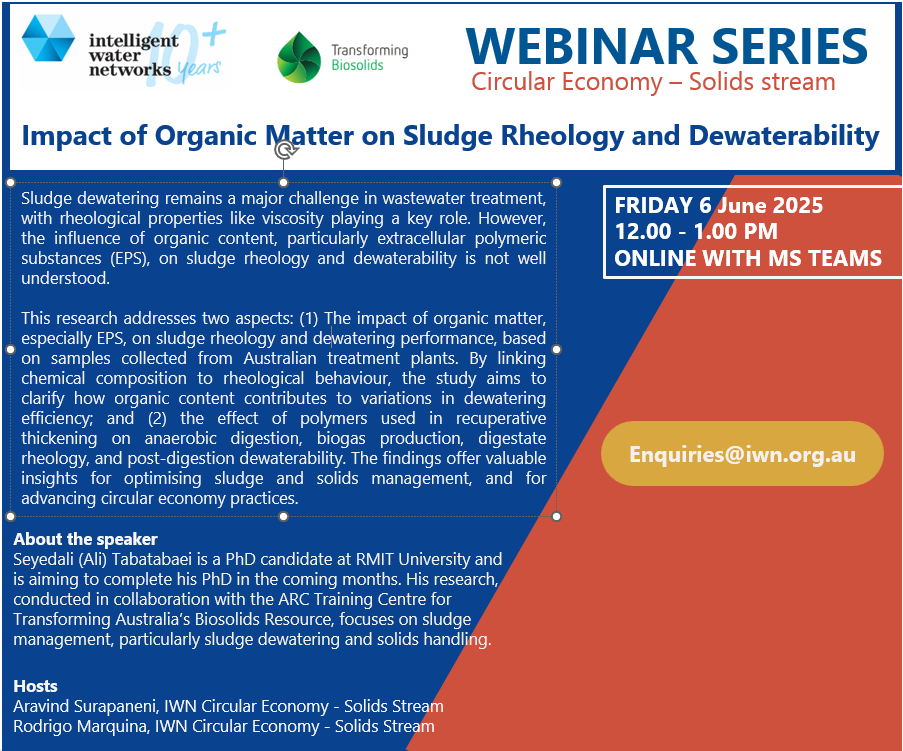
Below is the Flyer that was published for this event:
Impact of Organic Matter on Sludge Rheology and Dewaterability
Sludge dewatering remains a major challenge in wastewater treatment, with rheological properties like viscosity playing a key role. However, the influence of organic content, particularly extracellular polymeric substances (EPS), on sludge rheology and dewaterability is not well understood.
This research addresses two aspects:
(1) The impact of organic matter, especially EPS, on sludge rheology and dewatering performance, based on samples collected from Australian treatment plants. By linking chemical composition to rheological behaviour, the study aims to clarify how organic content contributes to variations in dewatering efficiency; and
(2) the effect of polymers used in recuperative thickening on anaerobic digestion, biogas production, digestate rheology, and post-digestion dewaterability.
The findings offer valuable insights for optimising sludge and solids management, and for advancing circular economy practices.
About the speaker
Seyedali (Ali) Tabatabaei is a PhD candidate at RMIT University and is aiming to complete his PhD in the coming months. His research, conducted in collaboration with the ARC Training Centre for Transforming Australia’s Biosolids Resource, focuses on sludge management, particularly sludge dewatering and solids handling.