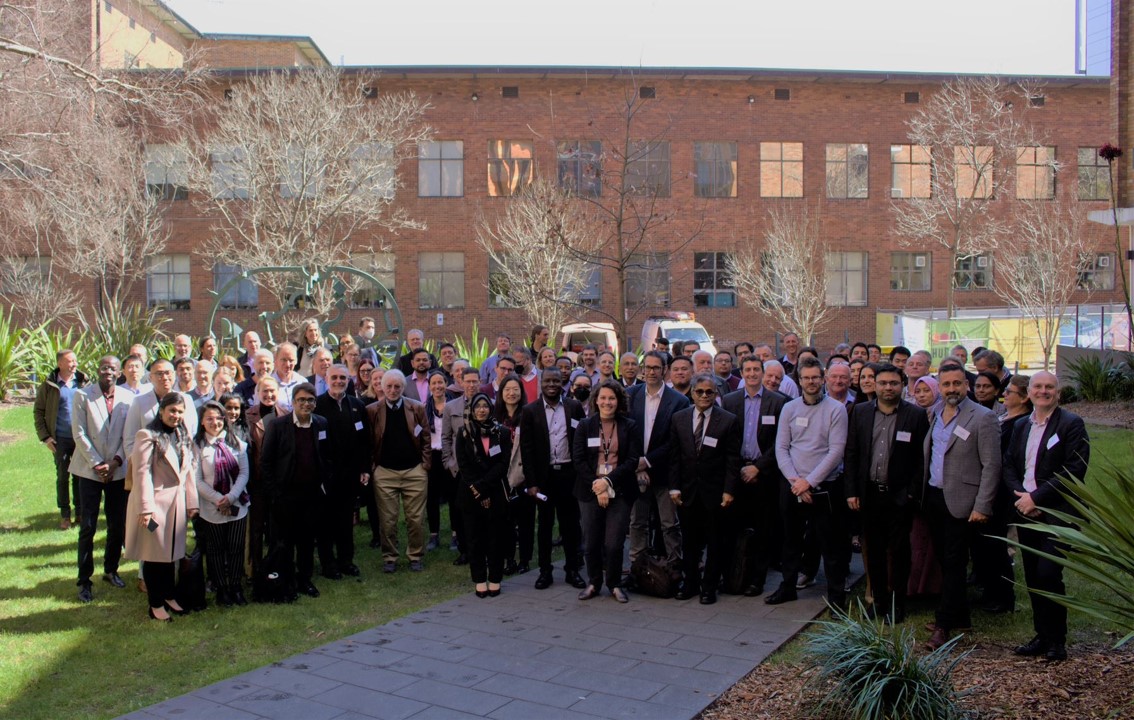
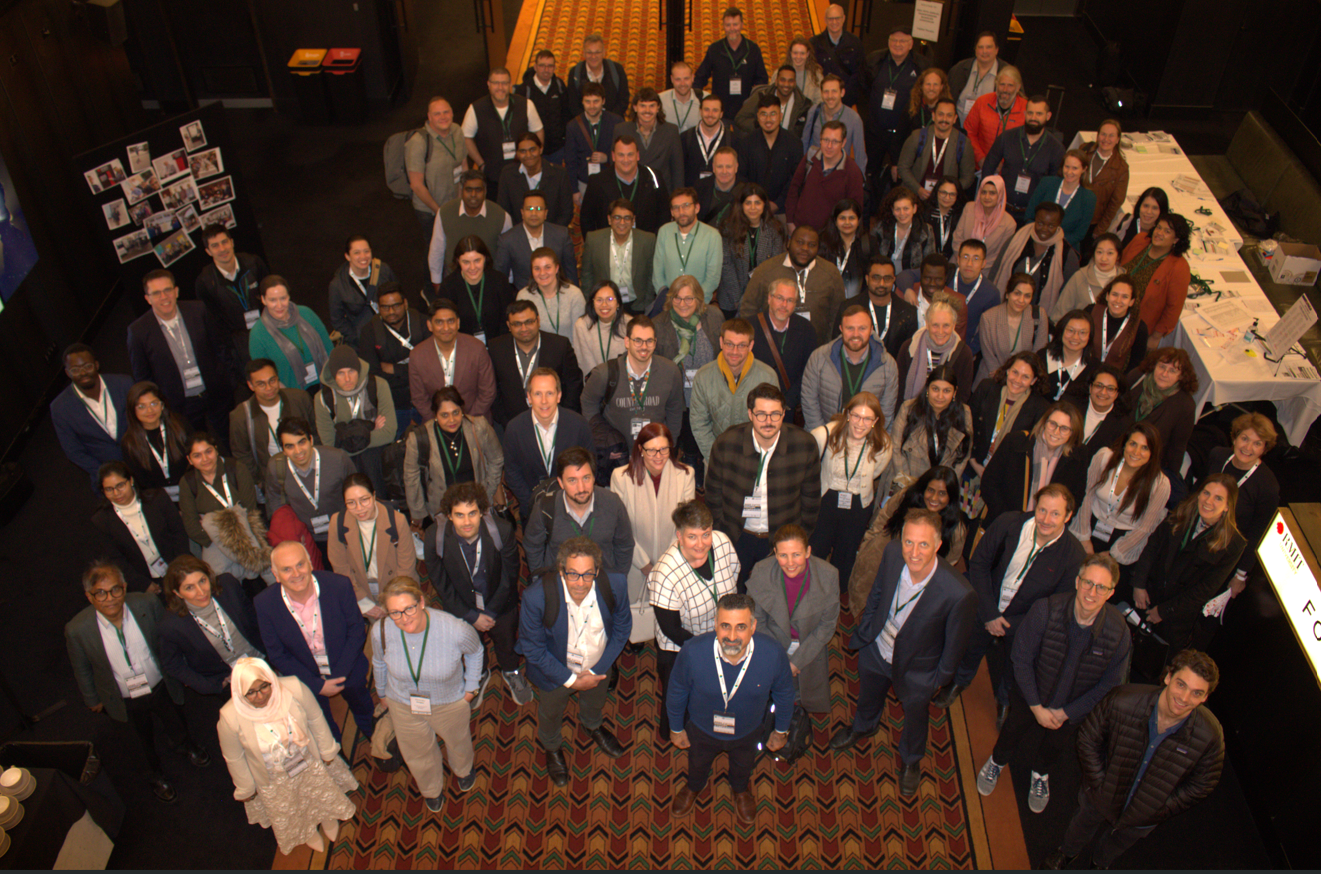
TRANSFORMING BIOSOLIDS CENTRE: Final Thank You

TRANSFORMING BIOSOLIDS CENTRE: Final Thank You

Author Editor
Updated March 2026

Dear All,

TRANSFORMING BIOSOLIDS CENTRE: Final Thank You

As 2025 marked the end of our five-year funding of the ARC Training Centre for the Transformation of Australia’s Biosolids Resource, I write to thank you all for your participation and support of the Centre during this period.

This week we submitted our final Annual Report to the ARC for the 2025 year, reflecting on what we have achieved in our last year.  Clearly with your help, we have built a strong community of biosolids industry partners, University personnel and Early Career Researchers through the Centre and are very proud of our scholars’ achievements in advancing knowledge addressing the transformation of biosolids during this time.

As a Training Centre, we have exceeded our original proposal and were involved in the training of

  • 23 International PhDs,18 Australian PhDs (total 41 candidates), and
  • 5 Australian Masters/Honours postgraduates.

We employed 28 Postdocs (9 Internationals) during the period and had the continued support and involvement of our 16 Chief Investigators and 27 Partner Organisations throughout the duration. While a significant number of our PhDs and Postdocs have been retained in academia, the Centre has significantly added to the biosolids industry employment pool by providing these highly qualified experts.

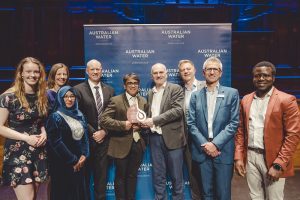
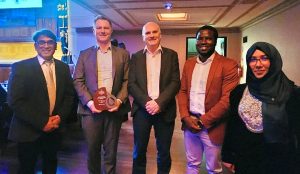
A recent highlight was the recognition given to our training and research impact, when the ARC Training Centre and consortium of industry partners won the Australian Water R&D Excellence Award for our “World’s First Transforming Biosolids Training Centre” at the Victoria Water Awards.  Victorian Water Award winners will go on to represent the state in the national Australian Water Awards, which will be presented at Australian Water Association’s annual water conference and exhibition, Ozwater’26, in Brisbane in May.

As you know, we have a further funding application before the ARC for a Research Hub, the results of which will not be known until late July 2026. We look forward to that outcome and the possibility of some of you continuing the journey with us if successful.

We have prepared the Draft ARC Final Report which will be submitted to the ARC in coming months once final updates to funding come through to RMS. Many thanks to our industry partners for your outstanding feedback on the usefulness of the work undertaken by the Centre that is recorded in this report.

The results of our work will continue to be uploaded onto the Transforming Biosolids website and Partner&Friends SharePoint. You can find the journal publications and industry reports on this website, plus Newsletters and Annual Symposium recordings on SharePoint via these links:

Finally, I invite you to contact the leadership team should you have any questions regarding the work of the Centre:

Please also follow up with any of our researchers via LinkedIn.

Thank you again for your support.

Kind regards,


Dist. Professor Andy Ball

Centre Director, ARC Transforming Biosolids Training Centre, RMIT University

Our Training Centre’s research recognised in the annual 2025 AWA awards held in Victoria!

Our Transforming Biosolids training centre recognised in the 2025 Victorian Water Awards!

Author Editor
Updated October 2025

UPDATE ON OUR NOMINATIONS:

Our ARC Training Centre research team is delighted to be recognised in the 2025 Australian Water Association’s (AWA) Victorian Water Awards along with our industry partners for this years R&D Excellence Award.  Results were announced on 16 October.

The R&D Excellence Award (sponsored by Water Research Australia) went to the following entry:

  •  South East Water Consortium with RMIT University, Melbourne Water, Environmental Protection Authority Victoria and Intelligent Water Networks (IWN) – Worlds First Transforming Biosolids Training Centre.

It has been a great team effort!

Congratulations to all award winners.


NOMINATED IN THREE CATEGORIES!

In this, our final year for the Centre, our Transforming Biosolids Training Centre was proud to have been included by association with our industry partners nominated among several of  the finalists in the Victoria Water Awards hosted by the AWA. We received  a mention in the following finalist categories:

  • Organisational Excellence Award – Producing great research and industry ready graduates from the Transforming Biosolids ITTC – Water Research Australia
  • R&D Excellence Award – World’s First Transforming Biosolids Training Centre – South East Water Consortium with RMIT University, Melbourne Water, Environmental Protection Authority Victoria and Intelligent Water Networks

In addition, one of our PhD candidates is shortlisted for her work as follows:

  • Student Water Prize – From Waste to Resource: Hydrothermal Treatment for Energy and Material Recovery in Water Recycling Plants – Kamrun Nahar, RMIT University

Biosolids Webinar Series – 6 June 2025 – Presenter: Seyedali(Ali) Tabatabaei RMIT

Webinar Series - Impact of Organic Matter on Sludge Rheology and Dewaterability. Presenter: Seyedali (Ali) Tabatabaei RMIT

Author Editor
Updated June 2025

This presentation is part of our ongoing webinar series being undertaken as part of the IWN Webinar Series Circular Economy – Solids stream.

This on-line webinar was presented on 6 June 2025.  The recording of this webinar can be found via the IWN members site .

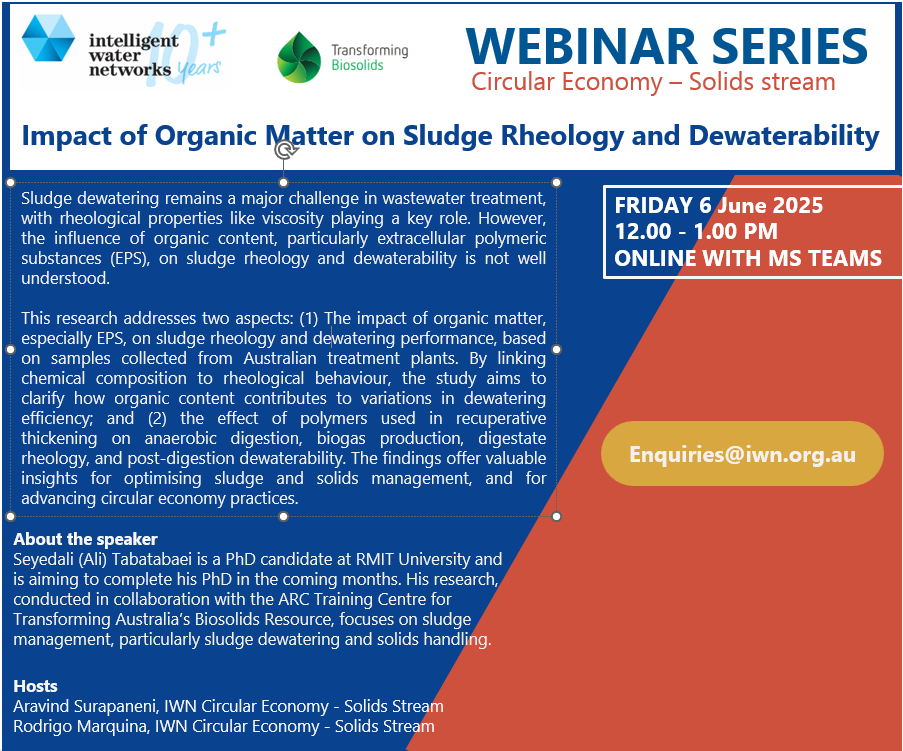
Below is the Flyer that was published for this event:

Impact of Organic Matter on Sludge Rheology and Dewaterability

Sludge dewatering remains a major challenge in wastewater treatment, with rheological properties like viscosity playing a key role. However, the influence of organic content, particularly extracellular polymeric substances (EPS), on sludge rheology and dewaterability is not well understood.

This research addresses two aspects:

(1) The impact of organic matter, especially EPS, on sludge rheology and dewatering performance, based on samples collected from Australian treatment plants. By linking chemical composition to rheological behaviour, the study aims to clarify how organic content contributes to variations in dewatering efficiency; and

(2) the effect of polymers used in recuperative thickening on anaerobic digestion, biogas production, digestate rheology, and post-digestion dewaterability.

The findings offer valuable insights for optimising sludge and solids management, and for advancing circular economy practices.

About the speaker

Seyedali (Ali) Tabatabaei is a PhD candidate at RMIT University and is aiming to complete his PhD in the coming months. His research, conducted in collaboration with the ARC Training Centre for Transforming Australia’s Biosolids Resource, focuses on sludge management, particularly sludge dewatering and solids handling.

ENQUIRIES – Contact enquiries@iwn.org.au

Biosolids Webinar Series – 29 May 2025 – Presenter Dr Christian Krohn RMIT

Webinar Series - Impact of microbial ecology on operation of biosolids treatment trains. Presenter: Dr Christian Krohn RMIT

Author Editor
Updated May 2025

This presentation is part of our ongoing webinar series being undertaken as part of the IWN Webinar Series Circular Economy – Solids stream.

This on-line webinar was presented on 29 May 2025.  The recording of this webinar can be found via the IWN members site .

Below is the Flyer that was published for this event:

Impact of microbial ecology on operation of biosolids treatment trains

In project 1C of the ARC Transforming Biosolids Training Centre we investigated microbial consortia to improve the management of biological sludge treatment. This topic is fascinating because the treatment reactor biomass includes a diverse range of naturally occurring microbes, which are crucial for the performance of sewage treatment systems. However, due to the complexities of biological systems and technological limitations, many important microbes remain unidentified, and their roles unclear, despite decades of research. These knowledge gaps present untapped opportunities for process optimisation.

A key objective was to understand the role of microbes in anaerobic digestion foaming, a problematic yet poorly understood phenomenon. By employing next-generation sequencing and advanced data science methods, we examined microbial consortia over time in both laboratory-scale and full-scale anaerobic reactors. The findings will be presented, and the long-term benefits of this research—including next-generation monitoring tools to enhance process health—will be discussed.

About the speaker

Dr Chris Krohn is a postdoctoral research assistant at RMIT University for Project 1C. Chris is fascinated by complex microbial systems and the tools to explore them. In 2021, he completed his PhD in soil science at La Trobe University, focusing on the role microbial ecology in the dissipation of legacy pollutants in soils. Chris is a recipient of the Nancy Millis Medal for exceptional high quality of a thesis and the CG Stephens medal for best PhD thesis in soil science.

ENQUIRIES – Contact enquiries@iwn.org.au

EVENT: RMIT University, Melbourne will host the 5th Annual Symposium for the ARC Transforming Biosolids Training Centre: 1 – 2 July 2025

EVENT: 5th Annual Symposium 2025 at RMIT University MELBOURNE 1-2 July 2025

Author Editor
Updated August 2025

THIS EVENT IS NOW OVER.

The 5th Annual Symposium for the ARC Training Centre for the Transformation of Australia’s Biosolids Resource will be held over 2 days at the RMIT University City Campus (Capitol Theatre), Melbourne CBD commencing on Tuesday 1 July 2025.

DATES 

  • 1 July 2025: Symposium program and Symposium Dinner
  • 2 July 2025 : Symposium program continued and Close.


REGISTRATION OPTIONS & DEADLINES

REGISTRATION IS REQUIRED TO ATTEND THIS EVENT FOR BOTH ON-LINE OR IN-PERSON ATTENDANCE.

Please register for your tickets at the following link: HERE

Please ensure you scroll down to ticket all options for both Day 1 and 2 attendances, the conference dinner or online registration. Thanks!

MONDAY 23 June 2025 at 5.00pm COB is the FINAL DATE/TIME FOR REGISTRATION for in-person attendance. Registration in-person HAS NOW CLOSED.


ONLINE ATTENDANCE AND LINK

Online attendance can be registered up until the event starts.


The Teams link details for online attendance is here:

Microsoft Teams Need help?

Join the meeting now

Meeting ID: 450 641 382 687 3

Passcode: Rp9Co6mA

Dial in by phone

+61 3 9067 5001,,531687334# Australia, Melbourne

Find a local number

Phone conference ID: 531 687 334#


COST

UNIVERSITY RESEARCHERS, INDUSTRY PARTNERS, INVITED GUESTS AND ONLINE ATTENDEES

Day time attendance is Free for University and Industry Partners, invited guests and online attendees.

Complimentary attendance at the Symposium Dinner is by invitation only for Partner organisations, guests and Centre researchers, with limited capacity.

If you are from a Partner organisation and have not received an invitation to the dinner, you are very welcome to attend at the non-partner dinner rate.


NON-INDUSTRY PARTNERS

A fee will be charged to Non-partner delegates attending in-person (Partners are listed HERE) for daily registration, day catering and the conference dinner.

  • $80 per day for registration and day catering ($160 for 2 days attendance)
  • $140 symposium dinner 


PROGRAM AND HANDBOOK

Please see HERE for the Final full Program.

Please see HERE for the Handbook for this event.

The Symposium brings together industry professionals, researchers and students from various national institutions. There will be a strong industry focus to connect industry with future leaders and researchers in the biosolids industry.

VENUES:

The 2 day Symposium is being held at the Capitol Theatre, (113 Swanston Street, Melbourne), an iconic heritage building in Swanston Street opposite the Melbourne Town Hall. The location is in the free tram zone and close to inner city train stations for easy access.

The Symposium Dinner is at the recently opened il Mercato Centrale at 546 Collins Street, in their Function Room on the top floor – a short walk or tram ride from the Capitol Theatre.

TRAVEL

If you are flying to Melbourne and arriving at Melbourne’s Tullamarine Airport, public transport to Southern Cross Station in Melbourne City is via SKYBUS. See HERE for information on Skybus ticketing and services.

Taxi and Uber stands are also located at the Arrivals Platform in the main Terminal – or in the nearby Parking building for arrivals at Terminal 4.

Once in the city, from Southern Cross Station, you can catch a free northbound tram on Collins Street to the Swanston Street stop to get to the Capitol Theatre. The Capitol Theatre is directly opposite the Melbourne Town Hall on Swanston Street.

You can also take a free tram south on Collins Street from The Capitol Theatre to the conference dinner venue, il Mercato Centrale, located just past King Street (cross street), about a block before Southern Cross Station.

The Melbourne CBD grid is in the Free Tram Zone. If you’re only travelling in the Free Tram Zone, your journey is free and you don’t need a myki.

View or download the metropolitan Melbourne tram network map (PDF) 522 KB


SPONSORSHIP:

Please see HERE for sponsorship opportunities.

If you are interested in sponsoring our event in 2025 in Melbourne: please contact:

Dr. Aravind Surapaneni (aravind.surapaneni@sew.com.au)

We are looking forward to the opportunity to continue discussions with our industry partners attending this event.

Thank you for your help and support.


THANK YOU TO OUR SPONSORS FOR SUPPORTING OUR EVENT.

Biosolids Webinar Series – 2 May 2025 – Presenters Dr Mojtaba Hedayati, Dr Arun Vuppaladadiyam & Dr Ibrahim Hakeem

Webinar Series - Joint presentation on "Non-agricultural Applications of Biosolids Biochar"

Author Editor
Updated April 2025

This joint presentation is part of our ongoing webinar series being undertaken as part of the IWN Webinar Series Circular Economy – Solids stream.

This on-line webinar is on 2 May 2025 at 12.00pm-1.00pm AEST

The recording of this webinar can be found via the IWN members site .

Below is the Flyer that was published for this event:

Non-agricultural Applications of Biosolids Biochar

As part of Project 2C of the ARC Transforming Biosolids Training Centre, a range of non-agricultural applications of biosolids biochar within and outside the water sector has been explored and results are really promising.

The Project involved comprehensive literature reviews, development of TOPSIS tool for shortlisting biochar applications, experimental investigations of about eight promising applications, fate of contaminants, techno-commercial feasibility, and factsheet development for biosolids biochar application.

This webinar will discuss details of few biochar applications, focusing on nutrient recovery from digester effluent and H2S removal from biogas as these applications demonstrate real circular economy solutions for the water sector.

Experimental findings will be presented including plans for scale up and pilot demonstration. Lastly, ongoing works and future research perspectives will be highlighted.


About the speakers

Dr Mojtaba Hedayati was a postdoctoral research assistant at RMIT University for Project 2C. He developed TOPSIS tool and focused on biochar use for nutrient recovery. He is currently with Rio Tinto Technical Development Centre. He completed his PhD in Chemical Engineering from RMIT with research focused on hydrothermal treatment of wet wastes.

Dr Arun Vuppaladadiyam was also a postdoctoral research assistant for Project 2C and focused on focusing on developing biochar/hydrochar from biosolids for H2S removal from biogas. He is now a lecturer in the School of Civil and Mechanical Engineering at Curtin University.

Dr Ibrahim Hakeem is a research assistant at RMIT University and currently leading the project in the Transforming Biosolids Training Centre.


ENQUIRIES – Contact enquiries@iwn.org.au

Biosolids Webinar Series – 28 March 2025 – Presenter Dr Lisha Liu UNSW

Webinar Series - Influence of US EPA Flux Chamber Configurations on Emission Measurements from Porous Media. Presenter: Dr Lisha Liu UNSW

Author Editor
Updated March 2025

This presentation is part of our ongoing webinar series being undertaken as part of the IWN Webinar Series Circular Economy – Solids stream.

This on-line webinar was presented on 28 March 2025.  The recording of this webinar can be found via the IWN members site .

Below is the Flyer that was published for this event:

Influence of US EPA Flux Chamber Configurations on Emission Measurements from Porous Media

Growing concerns over volatile organic compound (VOCs) emissions from area sources have underscored the need for accurate emission assessments, as these emissions can contribute to community complaints and environmental risks. A lack of best practice for accurately measuring volatile emission rates has hindered environmental assessments.

This webinar provides an overview of how the emission rates of VOCs from porous media (e.g. biosolids) are influenced by the configuration and methodology operation of an US EPA flux chamber and elucidate the potential mechanisms driving differences in VOC emission rates. Three porous media with varying moisture contents and two VOCs were selected to assess a range of flux chamber configurations and methodology operations. Further investigations focused on emissions from biosolids, examining the implications for complex gas mixtures (VOC, volatile sulfur compounds (VSCs)) and sensorial impact.

About the speaker

Dr Lisha Liu is a PhD candidate at the UNSW Air Quality and Odour Laboratory. She recently submitted her thesis and is an Odour Engineer at Stantec, Sydney Office. Her research was conducted in collaboration with the ARC Training Centre for Transforming Australia’s Biosolids Resource and focuses on benchmarking odour and VOC measurements from area sources, with a particular emphasis on biosolids.

ENQUIRIES – Contact enquiries@iwn.org.au

International Womens Day 2025 – Celebrating our researchers

International Womens Day 2025 - 8 March

Author Editor
Updated March 2025

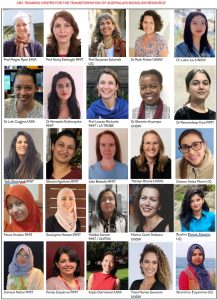
On this year’s International Womens Day, we proudly celebrate the inspiring women researchers, staff and PhD students within our Centre across our four Universities.  We acknowledge the fantastic work they contribute to  research outcomes and the sense of community they contribute to our team.

Biosolids Webinar Series – 5 March 2025 – Presenter: Dr James Hayes UNSW

Webinar Series - Community engagement within the biosolids stakeholder landscape. Presenter: Dr James Hayes UNSW

Author Editor
Updated March 2025

This presentation is part of our ongoing webinar series being undertaken as part of the IWN Webinar Series Circular Economy – Solids stream.

This on-line webinar was presented on 5 March 2025.  The recording of this webinar can be found via the IWN members site .

Below is the Flyer that was published for this event:

Community engagement within the biosolids stakeholder landscape

Biosolids experiences a set of unique factors, in particular odour, that affect the way in which industry-community engagement operates. Within nine years, biosolids as a market is anticipated to grow over 1 ½ times its current size. How well do current community engagement policies and mechanisms rise to these emerging opportunities and challenges?

This webinar provides an overview of three research methodologies used to understand the current community engagement policies as well as the stakeholder landscape of wastewater management and biosolids.

First, semi-structured interviews with company representatives for biosolids and community engagement were conducted to understand attitudes, beliefs, and policies.

Second, a scenario exercise that involved industry personnel, consultants, and environmental regulators was used to establish the relationships between these stakeholders and their objectives for moving towards best practice community engagement.

Third, complaint databases from wastewater companies were collected and analysed as to their efficacy in addressing odour and other environmental issues.

About the speaker

Dr. James Hayes is a Research Associate at UNSW, working at the Water Research Centre and the Air Quality and Odour Laboratory. He completed his PhD investigating the effect of malodour on communities. James’ research has involved the application of surveys, interviews, as well as psychometrics. He has also published in research relating to gas chromatography-mass spectrometry/olfactometry, considerations of the analysis of sulfur measurement, as well as novel research including odours of synthetic turf, detection dogs, engineering education, and humanitarian engineering.

ENQUIRIES – Contact enquiries@iwn.org.au

Biosolids Webinar Series – 6 February 2025 – Presenter Dr Curtis Rollins

Webinar Series - Public preferences for biosolids management approaches, and farmer preferences for organic-derived fertilisers - Dr Curtis Rollins UWA

Author Editor
Updated February 2025

This presentation is part of our ongoing webinar series being undertaken as part of the IWN Webinar Series Circular Economy – Solids stream.

This on-line webinar was presented on 6 February 2025.

The recording of this webinar can be found via the IWN members site .

Below is the Flyer that was published for this event:

Public preferences for biosolids management approaches, and farmer preferences for organic-derived fertilisers

This 3rd seminar will provide an overview of two survey-based research projects exploring biosolids management issues in Australia.

The first component explores public preferences for different biosolids management approaches and outcomes. Approximately 3000 survey responses were collected from a nationally representative sample of the Australian public. The analysis explores how members of the public make trade-offs between resource recovery, pollution reduction, and the financial cost of water treatment and biosolids management. We also measure public acceptance of different end-uses of biosolids-derived products.

The second component focuses on farmers’ preferences for organic-derived fertilisers, such as those created from biosolids. Organic- and waste-derived products are typically adopted at low rates relative to chemical fertilisers, in part because they provide significantly lower levels of nutrients. In this study, we explore the feasibility of marketing blended products that combine chemical and organic-derived fertilisers to farmers, and relative prices and nutrient levels in which farmers may consider switching from chemical fertilisers to organic-based alternatives. Responses to this survey were collected from a nationally representative sample of 200 farmers

About the speaker

Dr. Curtis Rollins is an environmental economics lecturer working for the Department of Agricultural and Resource Economics within the University of Western Australia School of Agriculture and Environment. Curtis’ research project with the ARC Training Centre for the Transformation of Australia’s Biosolids Resource focuses on decision-making relating to a wide range of environmental, agricultural and natural resource issues, including natural disasters, food system sustainability, biodiversity, and waste management issues

ENQUIRIES – Contact enquiries@iwn.org.au